Knee Pain When Going Up Stairs: Causes and What to Do
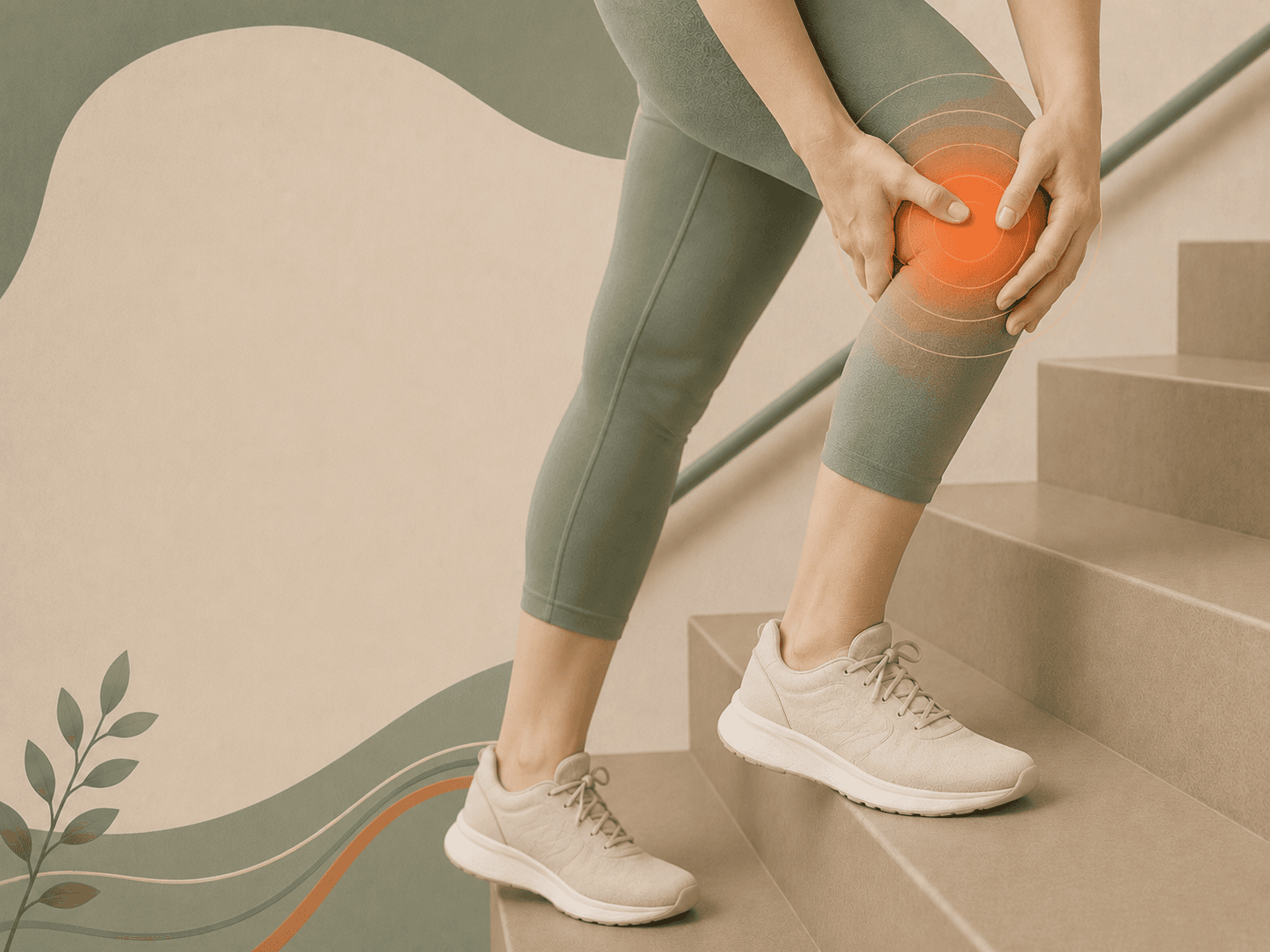
Going up stairs shouldn't be something you dread. But for many people, that simple movement of the body lifting against gravity produces a sharp pinch, a dull ache, or a worrying crunch somewhere around the knee. This load is distributed across the cartilage, tendons, ligaments, and the kneecap (patella) itself. When any of these structures is irritated, weakened, or damaged, that amplified force going up stairs is often exactly what tips discomfort into pain. It can happen suddenly after an injury, or creep in gradually until you find yourself choosing the lift without quite knowing when stairs became a problem. It is why people often notice knee trouble on stairs before they notice it anywhere else.
The good news is that knee pain on stairs is rarely a mystery. There are well-understood reasons it happens, clear patterns in where the pain sits, and effective ways to address it, often without surgery or long-term medication.
Pain location is one of the most useful clues in identifying what is driving knee symptoms:
Front of the knee (around or behind the kneecap): Most commonly associated with patellofemoral pain syndrome or chondromalacia patellae. Often described as a diffuse ache rather than a sharp point.
Just below the kneecap: Suggests patellar tendinopathy. Pain is usually localised and sharp, especially at the start of activity.
Inner (medial) side of the knee: May indicate medial compartment osteoarthritis, MCL irritation, or medial meniscus involvement.
Outer (lateral) side of the knee: Often related to IT band syndrome or LCL issues, particularly in runners.
Deep within the knee or behind the joint: Can indicate posterior cruciate ligament involvement, popliteal issues, or a Baker's cyst (fluid-filled swelling behind the knee).
Diffuse or difficult to localise: Sometimes seen in hypermobility, global osteoarthritis, or referred pain from the hip or lower back - which is more common than many people expect.
It is worth noting that pain can also be referred to the knee from the hip or lumbar spine without any problem in the knee itself. A thorough assessment will always look upstream and downstream from the painful area.
If the knee is acutely sore following an injury, a period of increased activity, or a flare-up with noticeable warmth or swelling, applying ice (wrapped in a cloth to protect the skin) for 15 to 20 minutes several times a day can help reduce inflammation and ease pain. Ice is most useful in the first 48 to 72 hours after an injury or a significant flare, when the inflammatory response is at its peak. Applying ice regularly but not continuously gives the tissue time to respond, and avoids the skin damage that can occur with prolonged exposure.
For longstanding, chronic knee pain, particularly osteoarthritis or stiffness that has been present for weeks or months rather than days, heat is often more helpful than ice. A warm compress or heat pad applied before movement helps increase blood flow, relax the surrounding muscles, and reduce the stiffness that makes the first few steps on stairs so uncomfortable. Many people find heat therapy most useful in the morning, before beginning daily activity, or before a planned walk. It is not appropriate for acutely inflamed or swollen joints, where it may worsen symptoms.
As a general guide: ice for acute and reactive pain; heat for chronic stiffness and muscular tightness. If you are unsure which applies to your situation, a physiotherapist can advise.
Complete rest is rarely the right answer for knee pain. The structures in and around the knee need appropriate load to heal and adapt. What matters is finding the right amount, enough to drive adaptation, not so much that symptoms flare. Avoiding stairs entirely for weeks often leads to deconditioning that makes the problem worse when activity resumes. Gentle, controlled movement, short walks, cycling on a stationary bike, swimming, keeps the joint nourished and maintains muscle function while reducing peak load through the painful structures.
Home management has its limits, and knee pain that persists beyond a few weeks, worsens progressively, or significantly limits what you can do deserves proper assessment.
A physiotherapist will conduct a detailed examination of the knee, assessing movement, strength, stability, and patellar tracking, alongside looking at contributing factors such as hip strength, foot mechanics, and how you move as a whole. They will also screen for signs that the knee needs imaging or onward referral to an orthopaedic specialist, such as significant structural damage, locking, or progressive degeneration that may warrant further investigation.
The assessment is diagnostic as much as it is therapeutic. Many people with knee pain have been told in passing that they have "a bit of arthritis" or "a weak knee" without understanding what that actually means for them or what they can do about it. A thorough physiotherapy assessment translates that into a clear picture of what is driving the pain and a specific, actionable plan.
Treatment may include hands-on techniques to reduce joint stiffness and soft tissue tension, a structured exercise programme targeting the weaknesses that are loading the knee incorrectly, taping or bracing to offload the kneecap in the short term, gait retraining, and advice on activity modification. For those with chondromalacia or osteoarthritis, physiotherapy is also central to understanding how to manage the condition long-term and maintain quality of life.
One of the most common reasons knee pain returns, or never fully resolves, is that treatment happens in sessions but does not transfer into daily habits. A good physiotherapy programme is designed with this in mind. Exercises should be specific enough to be effective but realistic enough that they fit into a busy day. Understanding the reasoning behind each component, why this exercise, why this load, why this timing makes it far easier to stay consistent. People who understand their condition adhere to their programmes significantly better than those who are simply handed a sheet of exercises.
The goal is not to keep returning for treatment indefinitely. It is to build enough understanding and physical capacity that you can manage your knee independently, with the knowledge of when to seek input if symptoms change.
At Form Foundry, we provide specialist physiotherapy for knee pain - from first assessment through to full recovery and self-management.
Our approach begins with a precise, evidence-based assessment to identify exactly what is driving your pain: whether that is a tracking issue at the kneecap, a ligament that needs support, degenerative change, or the residual effects of an injury that was never fully resolved. We do not offer generic programmes. Every treatment plan is built around the individual in front of us, with clear goals and measurable progress.
We also know when imaging or onward referral is appropriate, and we work with you to ensure that happens efficiently if needed.
If stairs have become something you avoid, or knee pain is limiting what you can do at work, in sport, or in everyday life, this is exactly what we are here for. Our clinics are based in Waterloo, Bank, and Hampstead, with appointments available seven days a week.
Book a free telephone consultation to speak with one of our physiotherapists and take the first step towards understanding and resolving your knee pain